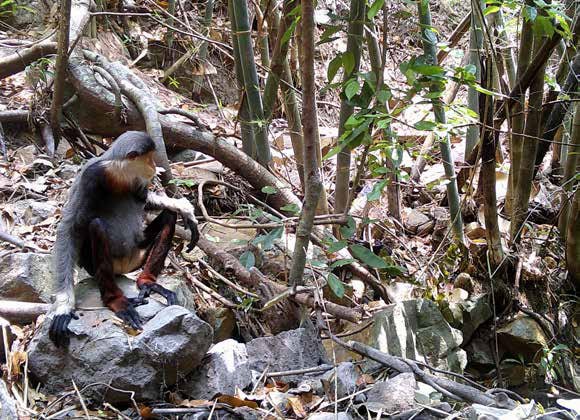
NEWS: Out of the 89 species detected by camera traps in Virachey National Park, about 19 are categorised as globally threatened on the IUCN Red List, according to a new biodiversity survey report released recently. Among them, there are 3 critically endangered, 3 endangered and 13 vulnerable. Moreover, 5 other species are near threatened.
Notable species included the critically endangered large-antlered muntjac Muntiacus vuquangensis, an elusive species endemic to the Annamites. These records included the first known image of a juvenile.

Other significant threatened species recorded included red-shanked douc langur Pygathrix nemaeus, gaur Bos gaurus, dhole Cuon alpinus, clouded leopard Neofelis nebulosa, Asiatic black bear Ursus thibethanus, Malayan sun bear Helarctos malayanus, Sunda pangolin Manis javanica and the ground-dwelling Germain’s peacock-pheasant Polyplectron germaini.
This information is based on 33,800 camera trap images. A total of 7,209 independent events were recorded. Of these records, 2,591 could not be identified beyond family and were excluded from the species richness calculations.

The remaining 4,618 records were comprised of 89 species: 41 mammals, 46 bird and 2 reptile species. A further 4 genera were detected and included in richness estimates that could not be identified to species level 2 birds and 2 mammals. Species richness varied between camera stations, from 2 to 31 species recorded.
Virachey National Park is a relatively understudied protected area in Northeast Cambodia, within the Siem Pang district, Stung Treng province, and Veun Sai, Taveng and Andong Meas districts in Rattanakiri province.
As a south-western extension of the Annamite Mountain range, the park is a key habitat for endemic flora and fauna not found in wider Cambodia, and despite relatively high levels of historic logging, remains a key biodiversity refuge. The park represents one of only two ASEAN Heritage Parks in the country.
Virachey National Park was established in 1993 by a Royal Decree, encompassing 332,500 ha. A subsequent contiguous Biodiversity Conservation Corridor was established by a Sub-Decree in 2018. In July 2023, likewise by Sub-Decree, the corridor was rezoned into Virachey National Park and is now part of the park, increasing the protected area to 405,766 ha.
A number of Indigenous groups live in and around the park including the Brao, Kavet, Kreung, Jarai and Kachork minorities, numbering approximately 35,000 people.